


Back in 1908 Trotsky wrote an analysis of art which displays his great sensitivity to the violence that pertains to the very form of artistic exhibition:
“You see, visiting art exhibitions is a terrible act of violence that we perpetrate on ourselves. This way of experiencing artistic pleasure expresses a terrible barracks-capitalist barbarism […] Let’s take a landscape, for example. What is it? A piece of nature, arbitrarily amputated, that has been framed and hung on a wall. Between these elements, nature, the canvas, the frame and the wall, a purely mechanical relation exists: the picture cannot be infinite, for tradition and practical considerations have condemned it to be square. So that it should not crease or buckle, it is framed, and so that it should not lie on the floor, people hammer a nail in a wall, fix a cord onto it, and hang up the picture by this cord. Then, when all the walls are covered in pictures, sometimes arranged in two or three rows, people call this an art gallery or exhibition. And then we are forced to swallow all this in one gulp: landscapes, genre scenes, frames, cord and nails…”
Should we read this perspicuous analysis as a call to abolish the violence of exhibiting a painting and return to organic unity of an art work with life? Trotsky may sound like this, but what he wrote in 1911 about Rodin’s famous sculpture The Walking Man (1907) clearly contradicts such a reading:
“Classical sculpture reproduced the human body in a state of harmonious peace. Renaissance sculpture mastered the art of movement. But Michelangelo used movement to express the body’s harmony more vividly. Rodin, on the other hand, made movement itself the subject of the sculpture. In Michelangelo the body creates for itself its own individual movement, whereas in Rodin, on the contrary, movement finds for itself the body it needs.”
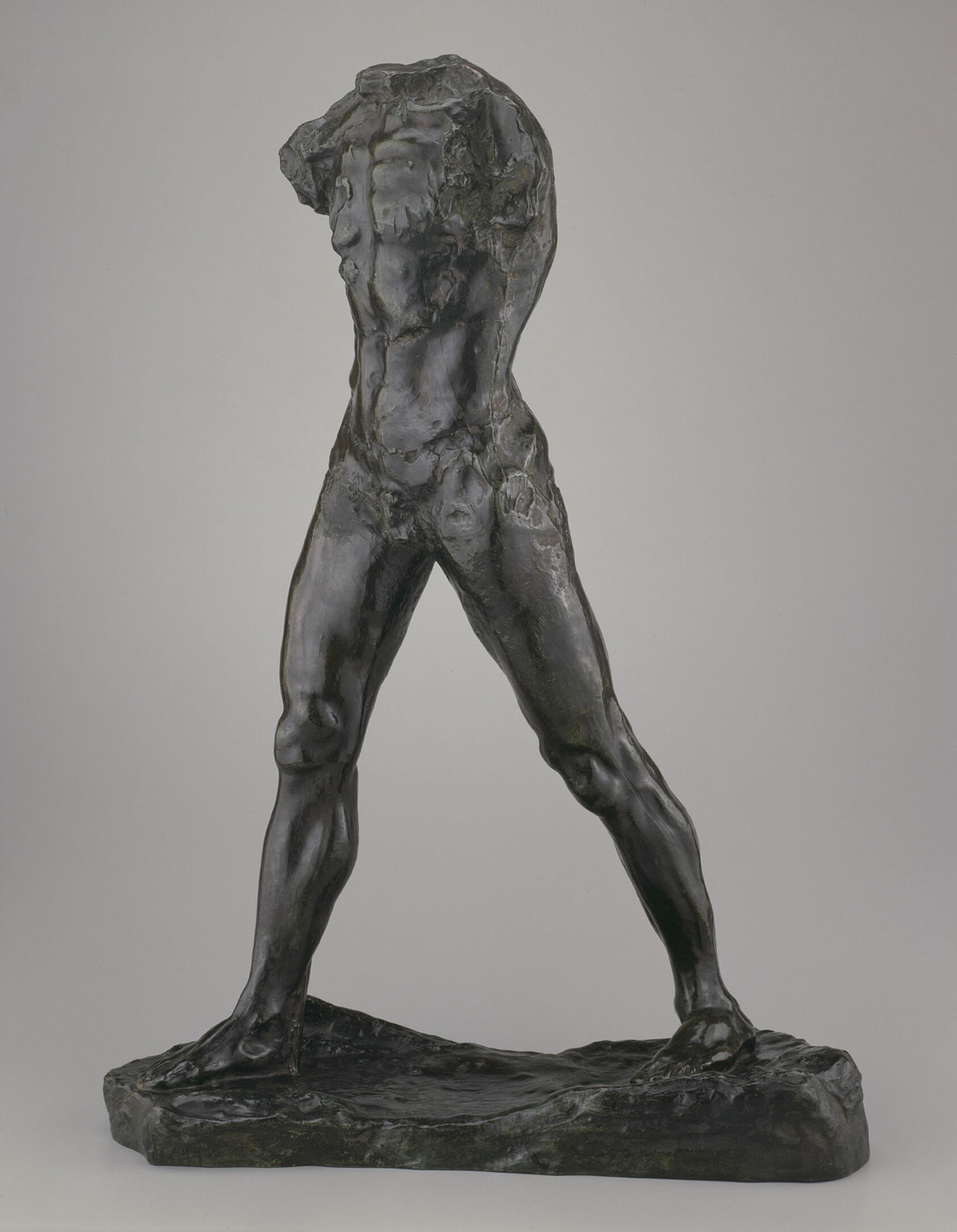
Here everything hinges on the precise meaning of the claim that “movement finds for itself the body it needs.” Is a movement that “finds itself a body it needs” part of this body, a material movement, or are we dealing with an ideal entity which selects its bodily expression from outside? Here is a standard idealist description of The Walking Man from the official website on Rodin:
“Breaking with tradition, he chose to portray a fragmentary figure in The Walking Man (1907) – a male torso, with neither head nor arms, planted on two legs opened like a compass. Having eliminated all anecdotal details to focus on the sensation of movement, Rodin produced an unprecedented and powerfully expressive interpretation of it, reiterating the force that had so captivated him when standing before incomplete antique statues and Michelangelo’s unfinished works.”
I think it is deeply wrong to read Rodin’s statue as an expression of the “desire to capture the impulses of the soul through bodily movement”. Assuming that we renounce the vulgar-materialist idea that matter is only substantial stuff, the basic lesson of quantum mechanics is that movement (quantum waves) is an irreducible component of matter. Matter is thus not a primordial substantial reality to which movement happens (or is even imposed from outside by some spiritual agency). It is along these lines, and following Alain Badiou, that Frank Ruda proposed the term “materialism without matter.” But we have to make a step further here and also de-idealize the violence involved in how Rodin treats the human body: the violence of brutally reducing the whole of a body to some of its parts (legs, torso) which leaves us with a monstrous freakish entity of legs walking alone with a torso. Here we encounter again the difference between idealism and materialism: is this violent dismembering of the body something performed by subjective reason, while external reality is composed of full bodies? Or is this violence of dismembering part of reality itself, in some sense more real than the “whole body”?
In one of the best known and often quoted passages from the Preface to Hegel’s Phenomenology, he seems to opt for the idealist version:
“The action of separating the elements is the exercise of the force of Understanding, the most astonishing and greatest of all powers, or rather the absolute power. The circle, which is self-enclosed and at rest, and, qua substance, holds its own moments, is an immediate relation, the immediate, continuous relation of elements with their unity, and hence arouses no sense of wonderment. But that an accident as such, when out loose from its containing circumference, – that what is bound and held by something else and actual only by being connected with it, – should obtain an existence all its own, gain freedom and independence on its own account – this is the portentous power of the negative; it is the energy of thought, of pure ego. Death, as we may call that unreality, is the most terrible thing, and to keep and hold fast what is dead demands the greatest force of all. Beauty, powerless and helpless, hates understanding, because the latter exacts from it what it cannot perform. But the life of mind is not one that shuns death, and keeps clear of destruction; it endures death and in death maintains its being. It only wins to its truth when it finds itself utterly torn asunder.”[i]
The violent dismembering is thus a feature of the “life of mind”… Nonetheless, an attentive reading complicates this idealist option. First, one should immediately note an unexpected choice of words that doesn’t fit the usual image of Hegel: Hegel praises as “the most astonishing and greatest of all powers, or rather the absolute power” Understanding (Verstand), NOT Reason (Vernunft). One usually opposes Understanding (the fixed “dead” abstract universal determinations) and Reason (the properly dialectical movement/mediation of abstract universals which make them “alive” again). But, as Hegel points out, the properly dialectical re-animation is to be sought in this very medium of “grey” notional determinations:
“The understanding, through the form of abstract universality, does give /the varieties of the sensuous/, so to speak, a rigidity of being /…/; but, at the same time through this simplification it spiritually animates them and so sharpens them.”[ii]
Spiritual animation is thus the animation of abstract universals: it remains at their level, and it does not signal a return to the immediacy of life. This is why Hegel celebrates as “the most astonishing and greatest of all powers, or rather the absolute power” Understanding and not Reason. Reason is not something that occurs beyond Understanding, reuniting into a new organic synthesis what Understanding divided into fixed determinations. Reason is Understanding itself without the idea that there is a substantial unknown beyond the divisions of Understanding. Kant remains at the level of Understanding when he limits the paradoxes of our reasoning to the limitation of our mind to the phenomenal world and posits that there must be things-in-themselves out of reach of our mind.
Let’s take a surprising example: Hotel Moscow built in 1936 and notable for its use of two different designs for the wings of its central structure.
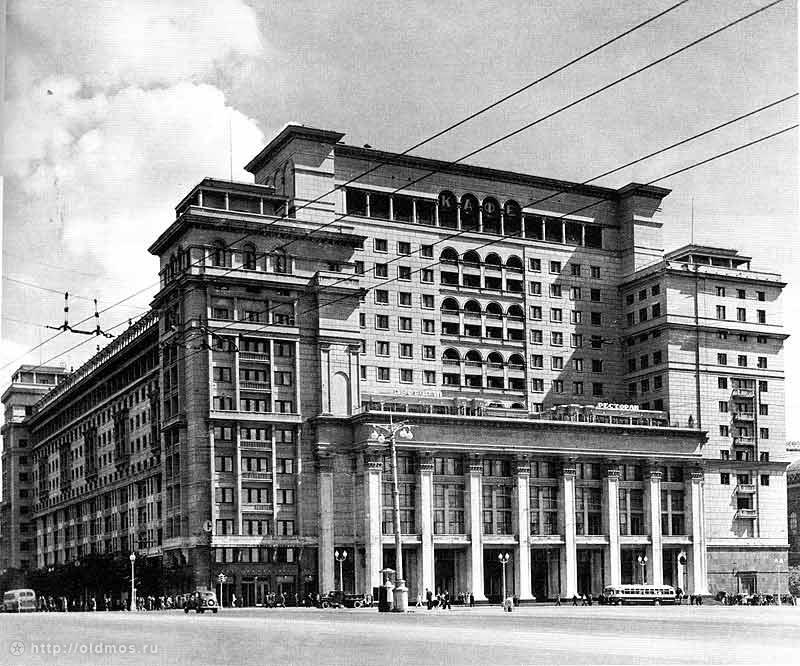
How did this weird imbalance arise? Alexei Shchusev, the architect, submitted a single conceptual drawing of the façade to Stalin, with one half showing one design option and the other half a different design option for the wings of the building. Stalin signed off on the drawing, without noticing the two options. Afraid of informing Stalin that he had failed to select a design, the decision was made to simply construct one wing of each design option, on either side of the building. One included large windows and a more ornate façade, while the other maintained the smaller windows and simpler details of the rest of the hotel’s façade. Even later, when the building was renovated and renamed as Four Seasons Hotel, this monstrous combination remained.
In Platonic terms, Hotel Moscow is an object which turns around the relationship between the Idea and its material actualization: it is an object which materializes two incompatible ideas, the idea with one type of windows on its two sides and the idea with a different type of windows. This is the focus of my interest here: how the same building can embody two different, even mutually exclusive, ideas. Therein resides the opposition between idealism and materialism: in idealism, a multitude of objects imperfectly realize an Idea (say, thousands of tables imperfectly realize the idea of a table), while in materialism, a material object realizes an inconsistent multiplicity of ideas—the contradiction is located in the Idea itself.
This brings us back to the violent tearing asunder of organic reality by Understanding. For Hegel, reality and reason are not abstractly separated, which means that tearing asunder is already in reality itself, not just in how our mind approaches reality. This is what Hegel aims at when he insists that we should grasp the Absolute not only as substance but also as subject. In a key passage from the Preface to Phenomenology of Spirit Hegel provides the most concise explanation of what it means to conceive Substance also as Subject:
“The disparity which exists in consciousness between the “I” and the substance which is its object is the distinction between them, the negative in general. This can be regarded as the defect of both, though it is their soul, or that which moves them. That is why some of the ancients conceived the void as the principle of motion, for they rightly saw the moving principle as the negative, though they did not as yet grasp that the negative is the self. Now, although this negative appears at first as a disparity between the “I” and its object, it is just as much the disparity of the substance with itself. Thus what seems to happen outside of it, to be an activity directed against it, is really its own doing, and Substance shows itself to be essentially Subject.”[iii]
Crucial is the final reversal: the disparity between subject and substance is simultaneously the disparity of the substance with itself—or, to put it in Lacan’s terms, disparity means that the lack of the subject is simultaneously the lack in the Other. Subjectivity emerges when substance cannot achieve full identity with itself, when substance is in itself “barred,” traversed by an immanent impossibility or antagonism. In short, the subject’s epistemological ignorance, its failure to fully grasp the opposed substantial content, simultaneously indicates a limitation/failure/lack of the substantial content itself.
Therein also resides the key dimension of the theological revolution of Christianity: the alienation of man from god has to be projected/transferred back into god itself, as the alienation of god from itself, wherein resides the speculative content of the notion of divine kenosis. This is the Christian version of Hegel’s insight into how the disparity of subject and substance implies the disparity of substance with regard to itself. This is also why the unity of man and god is enacted in Christianity in a way which fundamentally differs from the way of pagan religions where man has to strive to overcome his fall from god through the effort to purify his being from material filth and elevate himself to rejoin god. In Christianity, on the contrary, god falls from itself; he becomes a finite mortal human abandoned by god (in the figure of Christ and his lament on the cross “Father, why have you forsaken me?”), and man can only achieve unity with god by identifying with this god, god abandoned by itself. G. K. Chesterton made the same point when he wrote apropos of the fashionable claim about the “alleged spiritual identity of Buddhism and Christianity”:
“Love desires personality; therefore love desires division. It is the instinct of Christianity to be glad that God has broken the universe into little pieces /…/. This is the intellectual abyss between Buddhism and Christianity; that for the Buddhist or Theosophist personality is the fall of man, for the Christian it is the purpose of God, the whole point of his cosmic idea. The world-soul of the Theosophists asks man to love it only in order that man may throw himself into it. But the divine centre of Christianity actually threw man out of it in order that he might love it. /…/ all modern philosophies are chains which connect and fetter; Christianity is a sword which separates and sets free. No other philosophy makes God actually rejoice in the separation of the universe into living souls.”[iv]
And Chesterton is fully aware that it is not enough for God to separate man from Himself so that mankind will love Him. This separation HAS to be reflected back into God Himself, so that God is abandoned BY HIMSELF:
“When the world shook and the sun was wiped out of heaven, it was not at the crucifixion, but at the cry from the cross: the cry which confessed that God was forsaken of God. And now let the revolutionists choose a creed from all the creeds and a god from all the gods of the world, carefully weighing all the gods of inevitable recurrence and of unalterable power. They will not find another god who has himself been in revolt. Nay (the matter grows too difficult for human speech), but let the atheists themselves choose a god. They will find only one divinity who ever uttered their isolation; only one religion in which God seemed for an instant to be an atheist.”[v]
Because of this overlapping between man’s isolation from God and God’s isolation FROM HIMSELF, Christianity is “terribly revolutionary. That a good man may have his back to the wall is no more than we knew already; but that God could have His back to the wall is a boast for all insurgents for ever. Christianity is the only religion on earth that has felt that omnipotence made God incomplete. Christianity alone has felt that God, to be wholly God, must have been a rebel as well as a king.”[vi]
Consequently, being torn asunder is not just the basic state of entities in the world; it is also the state that characterizes the world itself, the position from which entities appear as torn asunder. Back to Rodin’s statue: the lesson of quantum mechanics applies here. There is no “objective” state of a thing as it really is; rather, every state appears as such only when it is “observed” (measured, registered) from a certain standpoint, and these standpoints are irreducibly multiple, there is no One World. With regard to any form of Absolute, there are entities in the world torn asunder because the Absolute itself is torn asunder, split in itself. What this implies from the Hegelian standpoint is that reconciliation is not the return to a restored organic unity, but the full acceptance of being-torn-asunder as the basic ontological feature of reality.
Notes:
[i] G.W.F. Hegel, Phenomenology of Spirit, Oxford: Oxford University Press 1977, p. 19.
[ii] Hegel’s Science of Logic, p. 611.
[iii] G.W. F. Hegel, Phenomenology of Spirit, trans. A. V. Miller, with foreword by J. N. Findlay (Oxford: Oxford University Press, 1977), 21.
[iv] G.K.Chesterton, Orthodoxy, San Francisco: Ignatius Press 1995, p. 139.
[v] Op.cit., p. 145.
[vi] Ibid.
The Author


